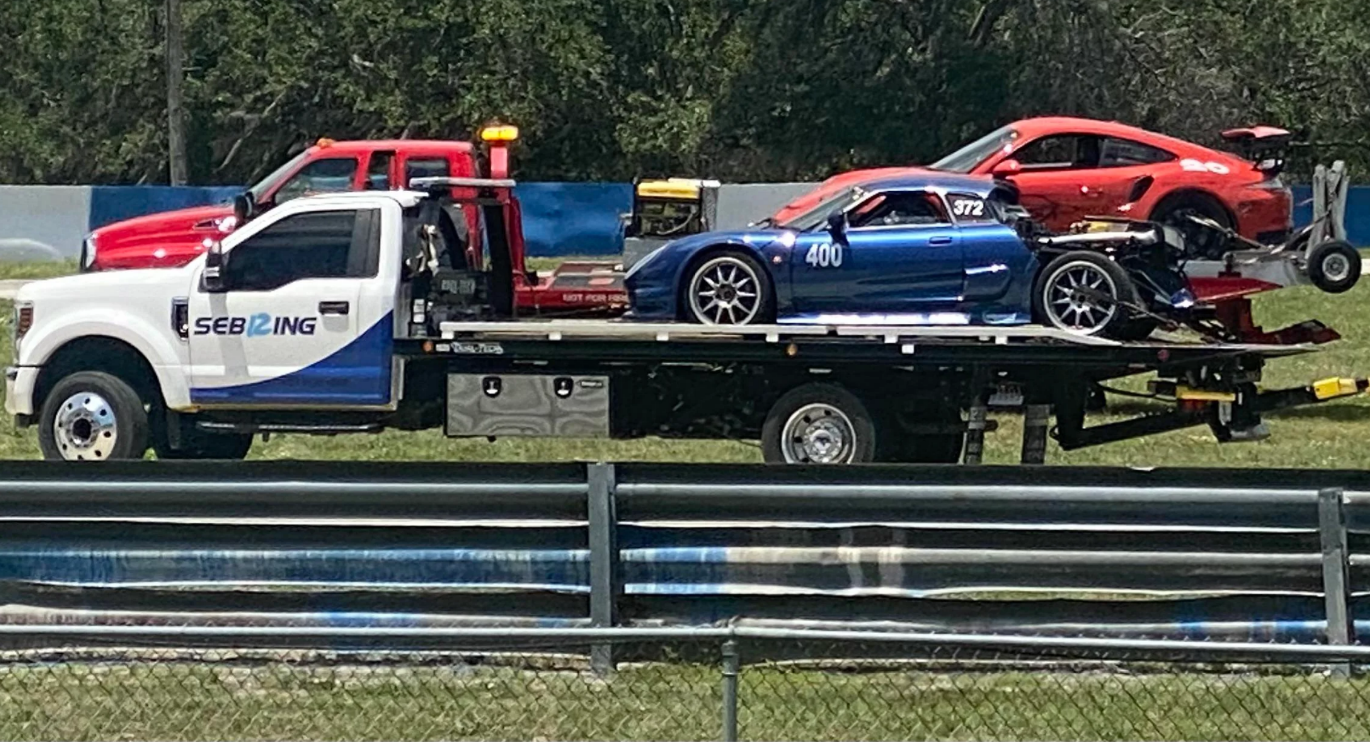
For many exotic-car owners, the idea of taking your Ferrari, Lamborghini, McLaren, Porsche Turbo or GT car to a track day feels irresistible. You finally get a chance to “use all the power,” test the limits, and feel like the car was meant to be driven.
But the truth is far less glamorous.
Exotic street cars are not designed for repeated, sustained track-day punishment.
They can do a few laps. They look incredible in the paddock. But mechanically and financially, they simply are not built for the environment of a real racing circuit—especially a demanding track like Sebring.
Before you sign up for a track day with your exotic, here’s what you need to know.
1. Heat Will Destroy Your Car Faster Than You Think
Exotics are optimized for street performance, not long, aggressive sessions.
On track you’ll face:
coolant temps spiking
oil temps exceeding safe limits
transmission temps skyrocketing
intercoolers heat-soaking
brake fluid boiling
Most modern supercars can run 3–5 hard laps before temperatures exceed safe thresholds. After that, the car tries to protect itself, reducing power or entering limp mode.
At tracks like Sebring—one of the most abrasive, high-load circuits in the country—the strain is even worse.
If you ignore the warnings?
You risk coolant system failures, turbo damage, and long-term engine wear that no warranty will touch.
2. Exotic Brakes and Tires Aren’t Built for This
Let’s talk carbon-ceramic brakes.
They’re spectacular on the road. On track? They can:
crack under repeated heavy heat cycles
glaze during cool-down
cost $12,000–$30,000 to replace
fail catastrophically if overheated
Street tires also cannot sustain track-level heat. They:
grease up after 10–15 minutes
lose predictable grip
degrade rapidly
often result in sudden oversteer or understeer
You’ll be chasing tire pressures and uneven wear all day.
3. Exotic Aerodynamics Look Cool… and Then Break
Exotics rely on:
carbon-fiber splitters
vented undertrays
diffusers
lightweight wings
active aero
Unfortunately, these pieces are:
low to the ground
fragile
extremely expensive
One curb strike at Sebring (and there are plenty of them) and you’re buying:
$7,000–$20,000 front splitters
$8,000 undertrays
$5,000 diffusers
$3,500+ side skirts
All because the car touched a curb it was never meant to touch.
4. Track Insurance on Exotics Is Not Cheap
Most exotic owners don’t know this until checkout:
A single track day of insurance for a $300k+ exotic can cost $1,200–$2,500
…and that still comes with limitations:
high deductibles
exclusions for certain circuits
exclusions for mechanical failures
no coverage for wear items
no coverage for wheels or aero damage
By the time you’ve insured it properly, you’re already approaching the price of an arrive-and-drive experience in a real race car.
5. Depreciation and Resale Risk
Buyers of used exotics are very sensitive to:
track use
high-temp engine logs
track mileage patterns
worn consumables
visible track rash
And yes—dealers can see the logs.
Many manufacturers store driver-behavior data, and track use reduces trade-in value on the spot.
6. You Aren’t Learning Proper Racecraft
This is a big one.
Exotics mask mistakes with:
traction control
stability software
active torque management
brake vectoring
rear steering
ABS programs that can brake individual wheels
You’re not learning to drive fast.
You’re learning to trust electronics.
A real race car:
communicates earlier
breaks away more predictably
teaches proper inputs
allows consistent lap-to-lap learning
gives real data feedback
behaves the same at temperature, session after session
If you’re serious about improving as a driver, your exotic isn’t the tool.
7. There’s a Smarter Option: Drive a Proper Race Car
This is where the decision becomes obvious.
Instead of punishing a $250k–$500k street car, you could drive a:
factory-built Audi RS3 LMS TCR race car
with:
full crew
pro-level coaching
real race data (AIM / Garmin Catalyst)
three-angle in-car video
proper slicks
proper aero
proper brakes
modular crash-repair construction
full FIA safety systems
Plus, you get:
curated hospitality
a private, controlled environment
a car designed to be driven at the limit for an entire day
no mechanical stress on your personal street car
no cargo or logistics
no depreciation
and no five-figure repair bills
A TCR car is built for what Sebring demands.
Your exotic isn’t.
Conclusion: Take the Car You Won’t Regret Driving Hard
If your exotic car is your pride and joy—or simply something you enjoy owning—you’re far better off leaving it off the racetrack.
A purpose-built race car delivers:
more speed
more consistency
more safety
more coaching value
more enjoyment
and dramatically lower financial risk
Your exotic belongs on beautiful roads.
Your fast laps belong in a real race car.